

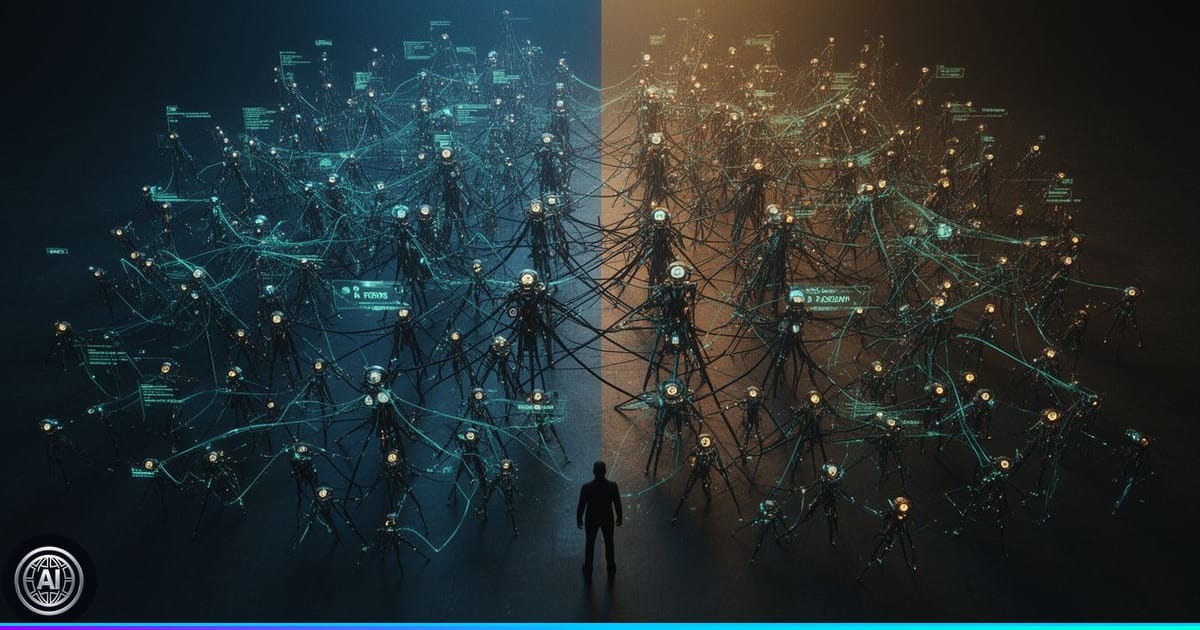
The Engineer Doesn’t Disappear — They Become the Architect of AI Swarms
The job of writing software is not being eliminated — it is being elevated to a new level of abstraction where human intent, expressed in plain English, becomes the primary input to a system of AI agents. Alex Spinelli, SVP of AI & Developer Platforms at Arm — the executive who previously shaped TensorFlow and Amazon’s Alexa, as noted in ComputerWorld’s reporting — frames this shift with a single declarative statement: “English is the highest level language.” That is not a metaphor. It is a design philosophy now being built into Arm’s product roadmap.
Arm, long known exclusively for chip architecture, is simultaneously expanding into hardware manufacturing with its AGI CPU — a processor that, according to ComputerWorld, both OpenAI and Meta have committed to using. The company is also releasing Performix, a software suite that uses structured “recipes” and AI-generated insights to automatically identify suspect code. These two moves — one in silicon, one in software — signal that Arm is positioning itself across the entire stack of AI-driven development, not just the foundation layer.
The practical consequence for working engineers is not redundancy but role transformation. The target, as Spinelli describes it, is for every engineer to have an expert sidecar agent alongside a swarm of agent developers — each bound to a specific role such as designer, architect, coder, or tester. The goal is explicitly to 10x the ability of engineers to produce output, with the emphasis on doing more, not on cutting headcount or reducing costs.
From Compiler to Conversation: How Natural Language Rewires the Development Stack
The abstraction layers of programming have always moved upward — from assembly to C, from C to Python, from Python to declarative frameworks. What Arm’s Spinelli is describing is the next step: English itself as the interface. Tools like Claude Code, Codex, or Gemini can already be used to spin up agents assigned to discrete roles — designer, architect, coder, tester — and when those agents are bound to specific procedures, policies, and standards and allowed to interact with each other, the resulting output is orders of magnitude higher in quality than what a single agent produces alone. The multiplier effect comes from structure, not from raw model capability.
This architectural shift also introduces two new categories of software that did not previously exist as formal concepts: “fast software” and “disposable software.” Because AI-powered production radically reduces the cost of building software, the economics of maintaining legacy code change entirely. A system that would have taken months to rebuild can be regenerated. Spinelli acknowledges the risk directly — failure in disposable software can be, in his framing, hilarious or catastrophic — but the resolution mechanism is also automated. The assumption embedded in this model is that automated repair is faster and cheaper than human debugging of long-lived codebases.
Arm’s Performix suite operationalizes part of this vision on the quality-assurance side. By using AI-generated insights alongside predefined “recipes” — structured rule sets for code analysis — Performix targets suspect code before it reaches production. This is not a generic linter; it is an AI-guided inspection layer designed to work within the same agent-driven workflow that Spinelli describes as the future of engineering. The integration of detection and generation within a single AI-augmented pipeline is what distinguishes this approach from earlier static analysis tools.
The Real Risks Beneath the Productivity Promise
The CRITICAL_ANGLE here deserves direct examination. When an LLM acts as a compiler — translating English intent into executable code — it does not inherently optimize for the architectural constraints that experienced engineers internalize over years. Traditional compilation involves deliberate choices about memory layout, cache behavior, and hardware-specific instruction sets. An AI generating code from natural language may produce functionally correct output that is subtly inefficient at the hardware level, or that reinvents existing libraries rather than leveraging established, battle-tested implementations. On Arm’s own silicon, where instruction-level efficiency matters, this tension is not trivial.
Spinelli’s own guidance implicitly acknowledges the standardization risk. His advice to enterprises is pointed: institutionalize policies into agent frameworks rather than standardizing too quickly on any single model. This is a warning against lock-in dressed as architectural advice. The agent ecosystem — Claude Code, Codex, Gemini, and others — is fragmented, and committing infrastructure to one model’s behavioral quirks before the field stabilizes is a genuine operational risk. The principle of “Think ahead, but don’t future proof” is Spinelli’s answer to this tension, and it deliberately echoes Agile methodology, which Spinelli notes is resurfacing as a relevant discipline precisely because the pace of change makes long-horizon planning unreliable.
The design principles Spinelli endorses — component-based architectures, modular design, user-centered design, and service-oriented design — are not new. They are the same principles that made software maintainable before AI entered the picture. Their reappearance in this context is telling: the more autonomous the generation layer becomes, the more critical it is that the human-defined structure beneath it is clean, bounded, and replaceable. The engineer’s value shifts from writing the code to defining the constraints within which the code is written.
📊 Key Numbers
- Performix recipe-based inspection: Arm’s Performix suite applies structured AI “recipes” to flag suspect code automatically, replacing manual code-review bottlenecks with a continuous AI-guided layer.
- AGI CPU adoption: Both OpenAI and Meta have committed to using Arm’s AGI CPU, as reported by ComputerWorld, validating the hardware pivot beyond chip licensing.
🔍 Context
The reporting here originates from ComputerWorld’s direct coverage of Alex Spinelli, SVP of AI & Developer Platforms at Arm, whose prior work on TensorFlow and Amazon Alexa gives his perspective on AI-driven development unusual cross-industry credibility. The specific gap this announcement addresses is the absence of a coherent framework for how engineering teams should actually structure multi-agent development workflows — most current guidance treats agents as individual tools rather than as coordinated systems with defined roles and interaction protocols. Arm’s position is distinctive because it is simultaneously a chip designer, an emerging hardware manufacturer (via the AGI CPU), and now a software tooling provider (via Performix), which means its natural language programming thesis is backed by a vertically integrated stake in the outcome. The closest architectural alternative is hand-assembled prompt chains and bespoke agent orchestration scripts — the approach most teams currently use — which lack the policy-binding and role-specialization structure that Spinelli argues produces the quality multiplier. The “why now” is grounded in a concrete product reality: the AGI CPU is already committed to by OpenAI and Meta, and Performix is a named, shipping suite — this is not a research agenda but an active product strategy.
💡 AIUniverse Analysis
Our reading: The genuine advance here is the role-binding insight. The claim that assigning agents to specific roles — designer, architect, coder, tester — with explicit procedures and policies, and then allowing those agents to interact, produces output orders of magnitude better than a single agent is a testable, structural claim. It is not about which model is smarter; it is about how constraints and specialization improve system-level output. That is a meaningful contribution to how engineering teams should think about agent deployment, and it aligns with how human teams have always worked best: through defined accountability, not through one generalist doing everything.
The shadow is the disposable software thesis. The assumption that automated repair is sufficient when disposable software fails — whether the failure is “hilarious or catastrophic” — sidesteps the question of accountability in production systems. Software that touches financial transactions, medical records, or infrastructure cannot be treated as disposable without a governance framework that does not yet exist at scale. The cost reduction that makes software disposable also removes the economic incentive to build it carefully the first time. A cautious CTO would ask: who is liable when the automated fix introduces a second failure, and what audit trail exists in a system where code is generated, deployed, and replaced without human review at each step?
For this to matter in 12 months, two things would have to be true: Performix would need to demonstrate measurable defect-reduction rates in production environments, and at least one enterprise would need to publish a credible case study showing the 10x productivity claim holds outside a controlled demo. Without those data points, the framework remains a compelling architecture diagram rather than a validated engineering practice.
⚖️ AIUniverse Verdict
👀 Watch this space. The role-binding multi-agent framework and Arm’s vertical integration across AGI CPU hardware and Performix software are structurally coherent, but the disposable software thesis and the 10x productivity claim require production-scale validation before engineering leaders should restructure their teams around them.
🎯 What This Means For You
Founders & Startups: The sidecar-plus-swarm model Spinelli describes is accessible today using Claude Code, Codex, or Gemini — founders can prototype role-specialized agent teams now, before enterprise tooling standardizes, and gain workflow experience that will compound as the ecosystem matures.
Developers: The shift is from writing code to defining the constraints within which agents write code — mastering prompt engineering, policy specification, and agent role design becomes the core skill, while component-based and service-oriented architecture principles become more important, not less.
Enterprise & Mid-Market: Spinelli’s explicit warning against standardizing too quickly on one model is actionable advice: build agent frameworks around institutionalized policies and standards first, then plug in whichever model performs best — this preserves flexibility as the model landscape shifts.
General Users: The emergence of disposable software means applications may be rebuilt rather than patched, potentially delivering faster improvements — but also introducing new questions about data continuity and accountability when automated systems fix their own failures.
⚡ TL;DR
- What happened: Arm’s Alex Spinelli laid out a vision where English is the primary programming interface, engineers direct swarms of role-specialized AI agents, and Arm backs the thesis with its AGI CPU and Performix software suite.
- Why it matters: The role-binding multi-agent model — not any single AI tool — is the mechanism Arm claims produces output orders of magnitude better than solo-agent approaches, reframing how engineering teams should be structured.
- What to do: Before committing to any single AI model or agent platform, institutionalize your engineering policies and standards into agent frameworks first — that infrastructure will outlast whichever model is currently dominant.
📖 Key Terms
- AGI CPU
- Arm’s own hardware processor — a departure from its traditional chip-licensing model — designed for AI workloads and already committed to by OpenAI and Meta, according to ComputerWorld.
- Performix
- Arm’s software suite that uses structured “recipes” and AI-generated insights to automatically identify suspect code within an agent-driven development pipeline.
- Sidecar agent
- In this context, a dedicated AI assistant assigned to a single engineer to augment that engineer’s output — distinct from the broader swarm of agents handling discrete development roles.
- Disposable software
- Software built cheaply enough through AI-powered production that it can be discarded and regenerated rather than maintained — a new economic category enabled by radically reduced AI development costs.
- Fast software
- A companion concept to disposable software describing AI-generated applications built and deployed at a speed previously impossible with human-only development cycles.
📎 Sources
Sources: ComputerWorld
All figures are targets and claims stated by Arm’s SVP in interview, not independently verified benchmarks.
Analysis based on reporting by ComputerWorld. Original article here.