

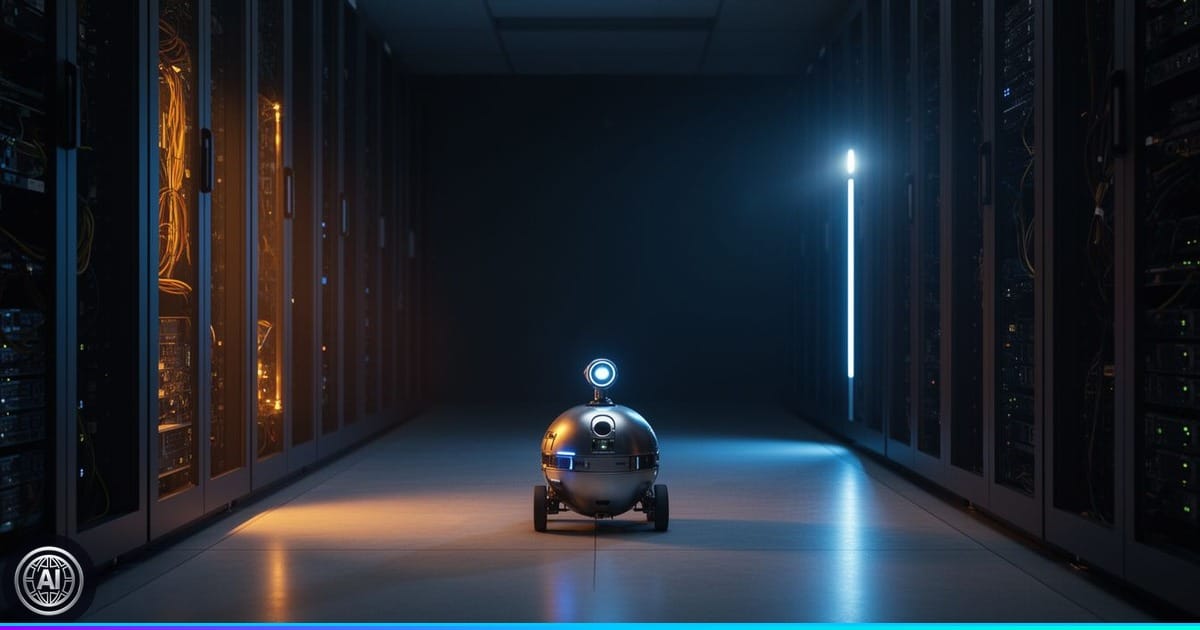
A notable advancement in physical AI, Google DeepMind has introduced Gemini Robotics-ER 1.6. This sophisticated model significantly bolsters robots’ capacity to comprehend and interact with the real world. Its release marks a crucial step toward more autonomous and perceptive machines in complex environments, particularly in industrial settings.
The system is designed to serve as the central reasoning engine for robots. It enhances their ability to understand spatial relationships, physical dynamics, and even detect successful task completion. This upgrade promises to make robots more intuitive and effective in performing a wider array of tasks.
Smarter Robots for Industrial Inspection
Google DeepMind released Gemini Robotics-ER 1.6, an embodied reasoning model built for robotic applications. This new version dramatically improves how robots handle spatial and physical reasoning. Capabilities like pointing, counting objects, and confirming task success are now more robust.
A standout feature is “instrument reading,” enabling robots to accurately interpret analog gauges and digital displays, achieving 93% accuracy using agentic vision. This is a massive leap from its predecessor, Gemini Robotics-ER 1.5, which previously managed only 23% accuracy in instrument reading and largely lacked this specific function.
Gemini Robotics-ER 1.6 functions as the “strategist” or “cognitive brain,” orchestrating complex actions. Complementing this, Gemini Robotics 1.5, a vision-language-action (VLA) model, handles the execution of motor commands. This division of labor allows for more nuanced control and planning in robotic operations.
Enhanced Physical Understanding and Application
The advanced pointing capability within Gemini Robotics-ER 1.6 is instrumental for sophisticated reasoning. It allows robots to map motion trajectories, pinpoint grasp locations for manipulation, and engage in constraint-based logic, mirroring human-like understanding of object interactions.
The model’s collaboration with Boston Dynamics’ Spot robot for facility inspection highlights its practical utility. Gemini Robotics-ER 1.6’s proficiency in reading instruments like pressure meters and sight glasses makes it invaluable for monitoring industrial environments, ensuring safety and efficiency.
Performance benchmarks show Gemini Robotics-ER 1.6 outperforming its predecessor, Gemini Robotics-ER 1.5. This improvement is particularly evident in object identification accuracy and a significant reduction in “hallucination,” where AI might generate incorrect or nonsensical information. This enhanced reliability is key for real-world deployment.
📊 Key Numbers
- Instrument Reading Accuracy: 93% (using agentic vision)
- Gemini Robotics-ER 1.5 Instrument Reading Accuracy: 23%
- Gemini Robotics-ER 1.6: Embodied reasoning model for robots
- Gemini Robotics-ER 1.5: Vision-language-action (VLA) model
🔍 Context
This announcement addresses the critical gap in AI’s ability to not just perceive but also interpret and act upon physical data in real-time. It fits into the broader AI trend of moving beyond abstract reasoning to sophisticated embodied intelligence. Unlike models focused solely on language or image processing, Gemini Robotics-ER 1.6 bridges the gap between sensing and actionable insight in physical spaces.
While numerous companies are developing AI for robotics, DeepMind’s focus on integrated “cognitive brains” with explicit instrument reading for industrial use is a specific differentiator. The recent acceleration in sophisticated sensor technology and increasing demand for autonomous industrial operations make this release particularly timely.
💡 AIUniverse Analysis
★ LIGHT: The true advance lies in Gemini Robotics-ER 1.6’s sophisticated instrument reading capability, moving beyond simple object recognition to nuanced interpretation of analog and digital readouts. This, combined with its enhanced spatial reasoning and the clear strategist-executor architecture, represents a significant step toward robots that can independently monitor and understand complex operational environments.
★ SHADOW: While impressive, the 93% accuracy for instrument reading is reported on internal benchmarks. The system’s integration with existing robotic control systems beyond calling user-defined functions isn’t fully detailed, and its real-world robustness in dynamic, unpredictable industrial settings remains to be fully proven. The full impact on large-scale deployment hinges on these factors.
For this to truly matter in 12 months, we need to see Gemini Robotics-ER 1.6 proving its value in diverse, challenging real-world industrial deployments beyond controlled demonstrations.
⚖️ AIUniverse Verdict
✅ Promising. The 93% instrument reading accuracy and enhanced spatial reasoning represent a significant leap for embodied AI in industrial settings, but real-world validation beyond internal benchmarks is crucial.
Developers: Developers can integrate Gemini Robotics-ER 1.6 for advanced robotic reasoning, enabling more sophisticated spatial understanding, planning, and the interpretation of complex sensor data like instrument readings.
Enterprise & Mid-Market: Enterprises can enhance operational efficiency and safety in industrial settings through robots capable of precise inspection and data interpretation, reducing human error and manual labor.
General Users: Everyday users may eventually benefit from more capable and reliable robots performing tasks in environments like factories or utility plants, leading to safer operations and potentially lower costs for services.
⚡ TL;DR
- What happened: Google DeepMind released Gemini Robotics-ER 1.6, an AI model that significantly enhances robots’ physical reasoning and instrument reading capabilities.
- Why it matters: This advancement enables robots to better understand complex environments, interpret sensor data like dials, and act more intelligently in industrial settings.
- What to do: Watch for real-world deployment data and benchmarks demonstrating the model’s robustness in diverse operational conditions.
📖 Key Terms
- embodied reasoning
- The AI’s ability to understand and interact with the physical world through a body, akin to how humans use their senses and limbs.
- vision-language-action (VLA) model
- An AI system that can process visual input, understand language instructions, and execute corresponding physical actions.
- instrument reading
- The capability of an AI or robot to accurately interpret data displayed on measurement devices, such as gauges and digital readouts.
- agentic vision
- A form of AI vision where the system actively seeks out and processes visual information to achieve a specific goal or make decisions.
- multi-view reasoning
- The AI’s ability to synthesize information from multiple perspectives or sensory inputs to form a comprehensive understanding of its surroundings.
Analysis based on reporting by MarkTechPost. Original article here.