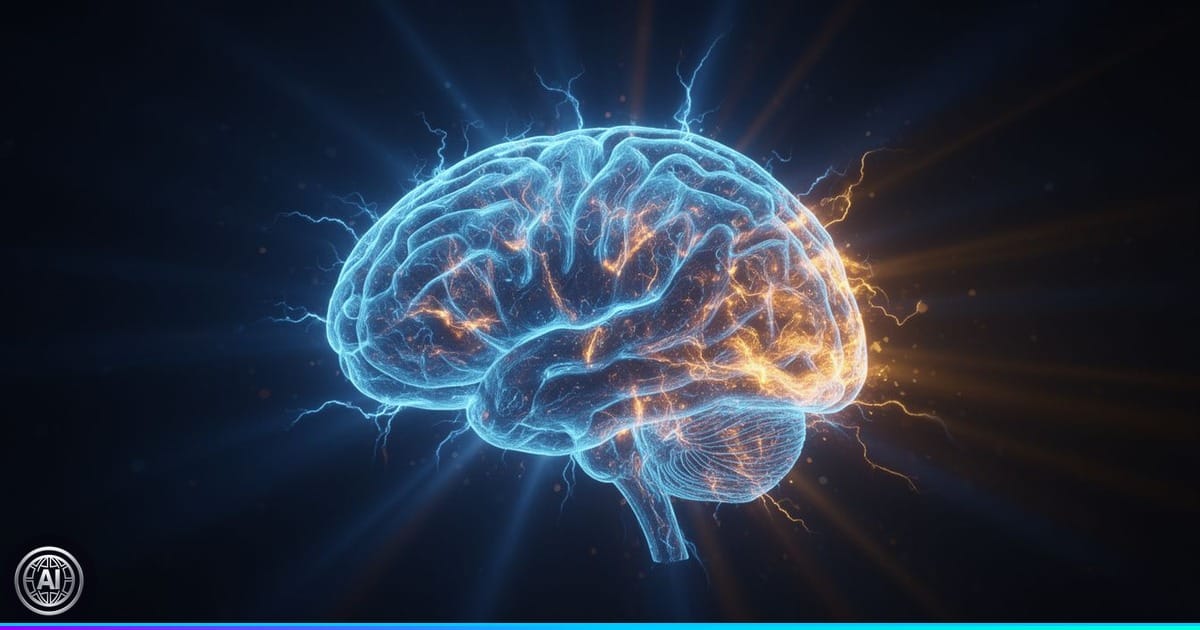
Meta AI has unveiled TRIBE v2, a groundbreaking model designed to understand how the human brain processes information from multiple sources simultaneously. This advanced system aims to bridge the gap between artificial intelligence and our biological understanding by predicting brain activity patterns. Its release marks a significant stride in decoding the complex interplay of sensory inputs that shape our perception and experience.
By analyzing brain scans, TRIBE v2 learns to correlate specific AI-generated content representations with real-time neural responses. This capability is crucial for developing AI that can more intuitively grasp human cognition, paving the way for more sophisticated human-computer interactions and deeper insights into how we process the world around us.
Unlocking the Brain’s Multimodal Language
TRIBE v2 demonstrates a remarkable ability to predict functional Magnetic Resonance Imaging (fMRI) signals, essentially “reading” brain responses to video, audio, and text. It achieves this by harmonizing AI representations with actual brain activity. The model leverages pre-trained AI components for each media type, such as LLaMA 3.2-3B for text and V-JEPA2-Giant for visuals, combined with a temporal transformer.
The sheer volume of data used for training—over 450 hours of fMRI scans from numerous individuals—underscores the model’s robustness. This extensive dataset allows TRIBE v2 to learn subtle patterns and show a continuous improvement in accuracy as more training data becomes available. Crucially, it also performs well even on subjects it wasn’t trained on, a feat known as zero-shot generalization.
The Road Ahead: Promise and Ponderings
While TRIBE v2 represents a significant leap towards comprehending how our brains integrate diverse sensory information, important questions remain. Its reliance on pre-existing AI models and distinct prediction mechanisms for different brain areas suggests that true, seamless generalization across all neurological states might still be a distant goal. The fundamental assumption that AI’s internal workings directly mirror the richness of human subjective experience requires deeper investigation.
Furthermore, the specifics of the “naturalistic studies” used for data collection are not fully detailed. Without more granular information on the content diversity and quality of these stimuli, it’s challenging to assess the model’s performance across a truly representative spectrum of human experiences. This lack of detail could mask potential biases or limitations in the training data itself.
🔍 Context
Meta AI, a leading research division of Meta Platforms, is at the forefront of developing advanced artificial intelligence systems. Their work spans across various AI domains, including natural language processing, computer vision, and neuroscience. This release of TRIBE v2 aligns with the growing trend in AI research to understand and model human cognition, seeking to create AI that is more aligned with human perception and understanding.
💡 AIUniverse Analysis
Meta’s TRIBE v2 is an ambitious project, pushing the boundaries of what AI can interpret from human brain activity. The ability to predict fMRI responses across multiple sensory modalities is a notable technical achievement, hinting at future AI systems that could interact with us on a more intuitive, neurological level. It’s a testament to the power of large-scale data and sophisticated deep learning architectures.
However, the current architecture, relying on frozen foundational models and specialized prediction modules, suggests an additive rather than deeply integrated understanding. This approach might struggle with the nuanced, subjective, and emergent properties of human consciousness. The challenge lies in moving beyond correlation to a causal understanding of how these stimuli translate into lived experience, a leap that AI has yet to make. We need to see more transparency in the training data and a clearer path towards models that don’t just predict but potentially “understand” human experience.
Developers: Developers can leverage these multi-modal encoding techniques to build more sophisticated brain-computer interfaces or neuroscience research tools.
Enterprise & Mid-Market: Enterprises can investigate applications in content creation, marketing, and user experience research by understanding audience neurological responses more deeply.
General Users: While direct user impact is distant, future applications could lead to more intuitive and responsive AI interactions or personalized therapeutic interventions.
⚡ TL;DR
- What happened: Meta AI launched TRIBE v2, a model that predicts brain activity from video, audio, and text.
- Why it matters: It’s a major step in AI understanding multisensory human perception and integrating with neuroscience research.
- What to do: Watch for advancements in AI-driven brain-computer interfaces and how this influences content creation and user experience.
📖 Key Terms
- fMRI
- A brain scanning technique that measures neural activity by detecting changes in blood flow.
- foundation model
- A large AI model trained on a vast amount of data that can be adapted for various downstream tasks.
- latent representations
- Internal, compressed forms of data that an AI model uses to understand complex information.
- voxel-wise encoding
- A method used in neuroscience to predict brain activity within specific small volumes of brain tissue.
- zero-shot generalization
- An AI’s ability to perform a task it hasn’t been explicitly trained on, using knowledge from its training.
Analysis based on reporting by AI Universe Source. Original article here.
Tools We Use for Working with AI: