

Local AI Compute in Your Handbag: NVIDIA’s Jetson Orin Nano Super Redefines Edge Robotics
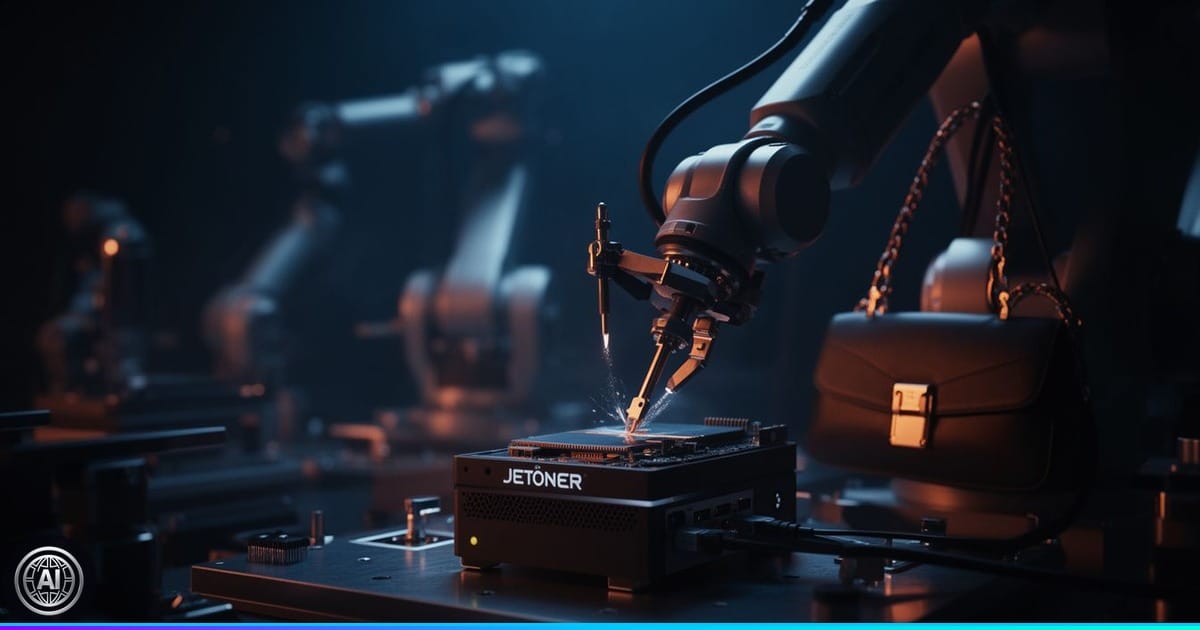
The physical development of robotics is moving out of server rooms and away from cloud APIs, directly onto local edge devices. This shift is powered by advancements like NVIDIA’s Jetson Orin Nano Super developer kit, which delivers 67 trillion operations per second (TOPS) of local AI compute in a form factor small enough to fit into a standard handbag. This compact power enables developers to build and deploy sophisticated AI agents directly on the hardware they control, fundamentally altering the landscape for autonomous systems.
Sarah Guo, founder of venture capital firm Conviction and co-host of No Priors, vividly demonstrated this portability, showcasing NVIDIA’s Jetson edge AI platform modules fitting inside a standard handbag. Her observation, “Bring the bag, Jetson brings the robot brain,” encapsulates the vision of bringing advanced AI processing to the point of action, rather than relying on remote infrastructure.
Local AI Unleashes On-Device Intelligence
The NVIDIA Jetson Orin Nano Super developer kit, according to NVIDIA Blog, delivers 67 trillion operations per second (TOPS) of AI performance, enabling desktop-class generative AI applications directly on the device. This capability allows for the local execution of open-weight models such as Mistral, as demonstrated by developer Coding with Lewis, who constructed an AI robot from scratch using the platform. Such on-device processing eliminates the need for constant internet connectivity or cloud API keys at runtime, a critical advantage for real-world robotic deployments.
Further supporting this shift, NVIDIA Blog states that Jetson Device Skills and Jetson BSP Skills provide builders with software capabilities specifically designed to deploy coding AI agents for edge robotics optimization. This integrated software stack facilitates the creation of systems like the Reachy Mini Jetson Assistant, which operates a low-latency voice and vision assistant entirely locally on the Jetson Orin Nano Super. For more demanding applications, the NVIDIA Jetson AGX Orin delivers 275 TOPS of AI performance, according to NVIDIA Blog, capable of running advanced computer vision, generative AI, and autonomous navigation workloads. This higher-tier module is notably utilized by a Carnegie Mellon University robotics team to power “SMoRes,” an autonomous system that builds 3D maps while searching for survivors in rescue environments.
Navigating the Edge: Power, Performance, and Proprietary Risks
While the promise of extreme portability and local compute density is compelling, deploying desktop-class generative models at the physical edge introduces significant engineering challenges. These include severe power, thermal, and memory bandwidth constraints, which are often less pronounced in cloud-hosted infrastructure. It is important to note that the stated TOPS figures, such as the 67 TOPS for the Jetson Orin Nano Super and 275 TOPS for the Jetson AGX Orin, represent peak theoretical performance and may vary based on specific workload optimization and thermal conditions. Real-world inference latency benchmarks can differ from vendor-provided marketing claims regarding ‘desktop-class’ performance.
Furthermore, relying on vendor-specific tooling like Jetson BSP Skills, while offering immediate development advantages, risks deep lock-in to NVIDIA’s proprietary hardware and CUDA ecosystem. This creates potentially high switching costs for developers and organizations who might later seek lower-cost or lower-power custom silicon solutions for mass production. Maintaining a clear distinction between the capabilities of the Jetson Orin Nano Super developer kit and the more powerful Jetson AGX Orin is crucial to avoid hardware capability confusion when planning deployments.
📊 Key Numbers
- Jetson Orin Nano Super AI Performance: 67 trillion operations per second (TOPS)
- Jetson AGX Orin AI Performance: 275 trillion operations per second (TOPS)
- Local Generative AI: Supports on-device execution of open-weight models like Mistral, eliminating cloud dependencies.
- Edge Robotics Software: Jetson Device Skills and Jetson BSP Skills enable deployment of coding AI agents for optimization.
- Autonomous Rescue System: Jetson AGX Orin powers Carnegie Mellon University’s SMoRes system for 3D mapping and survivor search.
🔍 Context
This announcement addresses the growing demand for robust, high-performance AI capabilities directly at the edge, particularly for robotics and autonomous systems. Historically, deploying complex generative AI or advanced computer vision models required significant server-room infrastructure or constant connectivity to cloud-hosted APIs. NVIDIA’s Jetson Orin Nano Super and Jetson AGX Orin platforms accelerate the trend of decentralizing AI compute, enabling real-time decision-making and operation in environments where internet access is unreliable or latency is critical. This contrasts sharply with traditional cloud-dependent architectures, offering a pathway to greater autonomy and data privacy for edge devices. The availability of these powerful, compact modules allows developers to move beyond simulation and prototype physical AI agents with unprecedented local processing power.
💡 AIUniverse Analysis
Our reading: The genuine advance here lies in the unprecedented density of AI compute delivered in such a compact form factor. The Jetson Orin Nano Super’s ability to execute open-weight generative models like Mistral locally, achieving 67 TOPS, fundamentally changes the prototyping and deployment workflow for physical robotics. This allows developers to iterate on complex AI behaviors directly on the device, bypassing the latency and cost associated with cloud APIs and enabling truly autonomous operation in disconnected environments. The integration of Jetson Device Skills and Jetson BSP Skills further streamlines the development of sophisticated edge AI agents.
However, this promise comes with significant caveats. While NVIDIA emphasizes portability, the practical deployment of desktop-class generative models at the edge introduces severe power, thermal, and memory bandwidth constraints that are often downplayed. The stated TOPS figures represent peak theoretical performance, and real-world inference latency benchmarks may not always align with marketing claims. Moreover, the reliance on NVIDIA’s proprietary Jetson BSP Skills and CUDA ecosystem creates a risk of vendor lock-in, potentially leading to high switching costs for developers seeking alternative, lower-cost, or lower-power custom silicon solutions for scaled production. For this technology to truly matter in 12 months, NVIDIA will need to demonstrate robust real-world performance benchmarks under varied thermal conditions and address concerns around ecosystem lock-in for mass-market adoption.
⚖️ AIUniverse Verdict
👀 Watch this space. While the local compute density is impressive, the long-term viability for mass production depends on addressing power, thermal, and vendor lock-in challenges beyond the developer kit stage.
🎯 What This Means For You
Founders & Startups: Hardware and robotics founders can rapidly prototype physical AI agents and demo autonomous systems live without relying on cloud infrastructure.
Developers: Developers gain the ability to deploy Vision-Language-Action (VLA) models and agentic models locally on low-latency embedded hardware with zero cloud API dependencies.
Enterprise & Mid-Market: Enterprise teams can implement edge automation, computer vision, and autonomous rescue systems while keeping operational data completely on-device for security compliance.
General Users: Everyday users will interact with faster, more reliable physical robots and assistants that can execute complex tasks offline.
⚡ TL;DR
- What happened: NVIDIA’s Jetson Orin Nano Super developer kit offers 67 TOPS of local AI compute in a portable, handbag-friendly form factor.
- Why it matters: It shifts physical robotics development from cloud to local edge devices, enabling on-device generative AI and autonomous operation.
- What to do: Evaluate the Jetson Orin Nano Super for edge AI projects, but scrutinize real-world performance and potential vendor lock-in for production deployments.
📖 Key Terms
- Jetson Orin Nano Super
- A compact developer kit from NVIDIA delivering 67 TOPS for local AI compute, designed for edge generative AI applications.
- Jetson AGX Orin
- A more powerful NVIDIA module offering 275 TOPS, suitable for advanced computer vision, generative AI, and autonomous navigation workloads.
- TOPS
- Trillion Operations Per Second, a measure of a processor’s AI performance, indicating how many operations it can perform in a second.
- Jetson BSP Skills
- Software capabilities provided by NVIDIA to assist builders in deploying coding AI agents for optimizing edge robotics.
- Vision-Language-Action models
- AI models that integrate visual perception, language understanding, and the ability to perform physical actions, crucial for advanced robotics.
Editorial note: This article summarizes NVIDIA Blog’s own product material, not independent reporting. Time-to-value, speed, and ROI statements reflect the publisher unless outside evidence is cited. Original post.
Analysis based on reporting by NVIDIA Blog. Original article here.