
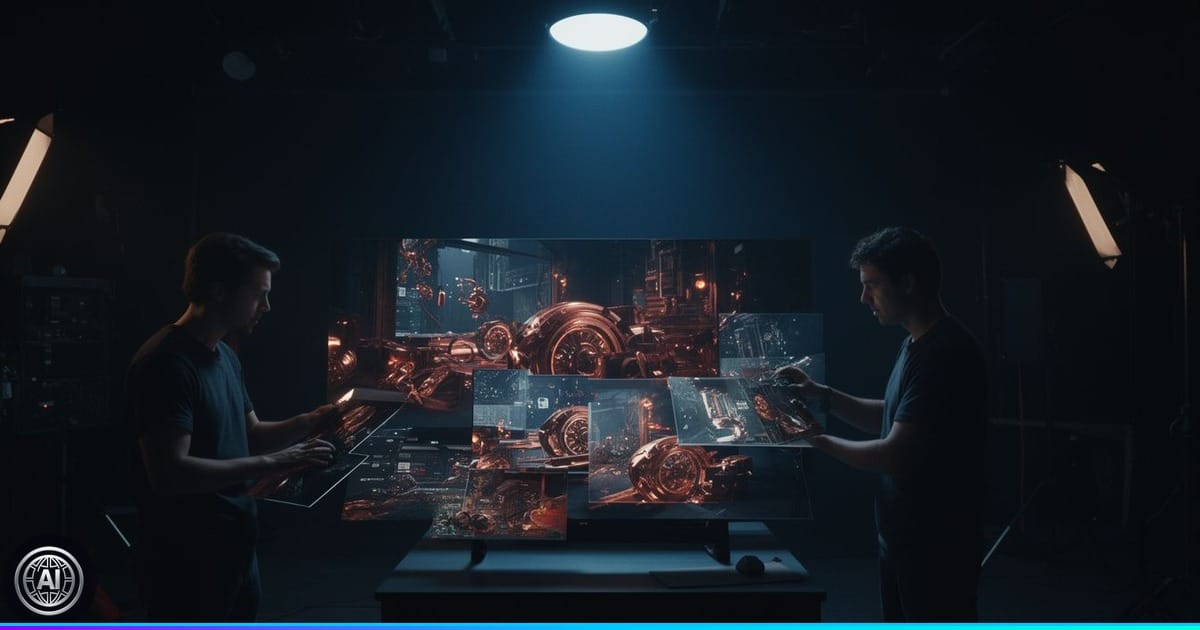
Google AI has just unveiled Veo 3.1 Lite, a significant new offering designed to democratize generative video creation. This move aims to tackle the substantial cost often associated with producing AI-generated video content. By making this advanced model accessible through the Gemini API, Google is empowering developers and businesses to explore new creative frontiers without breaking the bank.
The core appeal of Veo 3.1 Lite lies in its impressive cost-performance ratio. Google AI has managed to deliver generation speeds that rival their higher-tier Veo 3.1 Fast model, but at roughly half the price. This makes it a far more palatable option for projects that require iterative development or high-volume output, a crucial factor for scaling applications.
Making High-Quality Video Generation More Accessible
Veo 3.1 Lite supports generating videos in high definition, offering outputs at both 720p, priced at $0.05 per second, and 1080p, costing $0.08 per second. Users can choose clip durations of 4, 6, or 8 seconds, providing flexibility for various use cases. This accessibility is further enhanced by its availability via the Gemini API and Google AI Studio, specifically for paid tier subscribers.
Under the hood, the model leverages a sophisticated Diffusion Transformer (DiT) architecture. This approach processes information through spatio-temporal patches within a latent space, enabling efficient and coherent video generation. To address concerns about authenticity, Veo 3.1 Lite also incorporates SynthID, a tool designed to watermark AI-generated content, providing a layer of transparency.
Strategic Move to Lower Barriers for Developers
This release is clearly a strategic play by Google to dismantle the financial hurdles in generative video production. By positioning Veo 3.1 Lite as a developer-focused solution, the company signals its intent to foster broader adoption and experimentation. While the promise of “high speed” and “HD output” is appealing, the specifics of potential compromises in creative range compared to its premium sibling remain to be fully explored.
The emphasis on programmatic generation and quick prototyping suggests a target audience keen on integrating video creation directly into their existing pipelines. This offers a pathway for businesses to rapidly iterate on video assets for marketing, product demos, or interactive experiences, potentially accelerating the adoption of AI in creative workflows.
🔍 Context
Google AI, a leading research division of Google, consistently pushes the boundaries of artificial intelligence. Generative AI models, capable of creating novel content like text, images, and video, have seen rapid development in recent years. The Gemini API is Google’s platform for accessing its advanced AI models, aiming to streamline integration for developers and businesses.
💡 AIUniverse Analysis
Google’s introduction of Veo 3.1 Lite is a shrewd maneuver to capture a larger market share in the burgeoning generative video space. By prioritizing affordability and speed, they’re directly addressing a major pain point for developers and smaller content creators who might be priced out of more advanced tools.
However, the “Lite” moniker inherently suggests trade-offs. While the article highlights cost and resolution benefits, it leaves questions unanswered about whether developers will sacrifice finer control over stylistic elements or access to certain advanced generative features found in higher-tier models. This distinction will be crucial for users deciding which tier best suits their creative needs.
Ultimately, Veo 3.1 Lite appears to be engineered for efficiency and scale, making it an ideal tool for rapid prototyping and integration into existing content pipelines. It represents a pragmatic step towards making sophisticated AI video generation a more commonplace and affordable tool for a wider range of applications.
🎯 What This Means For You
Founders & Startups: Founders can now integrate cost-effective, high-speed video generation into their applications, enabling dynamic content creation for ads and social media automation at scale.
Developers: Developers can leverage the Gemini API with Veo 3.1 Lite to build video generation capabilities into their workflows, benefiting from improved temporal consistency and reduced computational demands.
Enterprise & Mid-Market: Enterprise clients can explore scalable, cost-efficient programmatic video generation for marketing and internal communications, with the added assurance of SynthID for content provenance.
General Users: End-users may experience a wider range of dynamic and personalized video content across various platforms, from social media to digital advertising.
⚡ TL;DR
- What happened: Google AI released Veo 3.1 Lite, a more affordable and faster video generation model accessible via the Gemini API.
- Why it matters: It significantly lowers the cost barrier for creating AI-generated video, making it more accessible for developers and businesses.
- What to do: Developers and businesses should evaluate Veo 3.1 Lite for cost-effective integration into their video creation workflows.
📖 Key Terms
- Diffusion Transformer (DiT)
- An AI architecture that combines elements of diffusion models and transformers for generating data, often used in image and video synthesis.
- latent space
- A compressed representation of data where AI models can more easily manipulate and generate new content.
- spatio-temporal patches
- Small segments of video data that capture both spatial information (pixels within a frame) and temporal information (how frames change over time).
- SynthID
- A Google AI tool used to add invisible watermarks to AI-generated content, helping to identify its origin.
Analysis based on reporting by MarkTechPost. Original article here.
Tools We Use for Working with AI: