

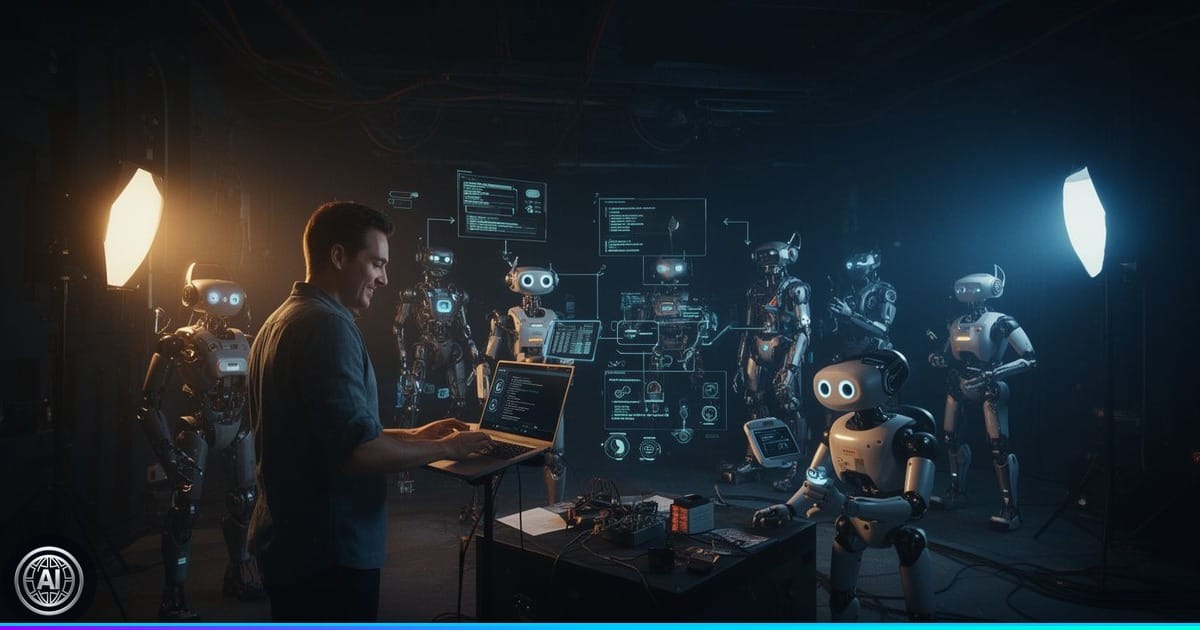
The race to build intelligent AI agents is accelerating, but the foundational infrastructure to reliably control and manage them in production environments has lagged significantly. Brian Douglas, a veteran of GitHub, has launched Paper Compute to address this critical gap, aiming to provide the essential “missing layer” for cloud-native AI agent operations. This development arrives as the proliferation of AI agents has outpaced the availability of robust, standardized tooling, mirroring the early days of cloud computing where similar infrastructure challenges emerged.
Building the Bedrock for AI Agents
Paper Compute is building a suite of tools designed to bring order to the chaotic world of production AI agents. Co-founded by Brian Douglas and CTO John McBride, the startup is focused on creating the underlying systems necessary for agents to operate reliably, securely, and with proper auditability. This endeavor is crucial because, as Brian Douglas states, “Everyone’s building agents, not enough people are building the systems underneath them.”
To address this, Paper Compute has already open-sourced Tapes, an observability layer designed to capture telemetry between agents and inference providers without requiring code modifications. Alongside Tapes, the company has released StereOS, a hardened operating system specifically for running AI agents in production, offering isolated, sandboxed environments. These initial offerings aim to provide much-needed visibility and control over AI agent activities in complex, real-world deployments.
The Parallel to Cloud-Native Evolution
Brian Douglas draws a direct parallel between Paper Compute’s mission and the emergence of Kubernetes over a decade ago. Just as Kubernetes became essential for managing containerized applications, Paper Compute envisions a similar role for its platform in orchestrating AI agents. This new infrastructure layer is intended to span observability, execution, and orchestration, providing a cohesive system for managing AI agents in production. The company’s name, “Paper Compute,” reflects a monetization model centered on compute usage and data flow, suggesting a future where agent session data could be transformed into reusable “skills.”
The need for such infrastructure is becoming increasingly apparent as enterprises, especially those in regulated sectors like banking, prepare to scale their AI agent deployments. Brian Douglas predicts that open-source solutions will commoditize AI agent tooling within the next six months, but emphasizes that tooling must also instill trust for running agents in production. This points to a critical bottleneck: ensuring reliability and security before widespread enterprise adoption can occur.
📊 Key Numbers
- Agent telemetry capture: Tapes captures telemetry between agents and inference providers without code changes.
- Production agent environments: StereOS provides isolated, sandboxed environments for AI agents in production.
- Control span: Paper Compute aims to establish a layer for running and managing AI agents in production that spans observability, execution, and orchestration.
- Market commoditization prediction: Brian Douglas predicts that open source will commoditize AI agent tooling within the next six months.
🔍 Context
Paper Compute arrives at a time when the rapid development of AI agents has created a significant gap in production-ready infrastructure, a problem that has become acute in the last three months. This surge in agent development is challenging existing cloud-native paradigms that were not initially designed for the complexity and unique needs of LLM-driven applications. Brian Douglas, a notable figure from GitHub’s early days, is directly addressing this emergent need with his new venture.
The closest market rivals offering similar capabilities in managing LLM interactions and agent workflows include platforms like LangChain and its observability tool, LangSmith. While these offer broad ecosystem integration and developer familiarity, Paper Compute’s approach, through tools like Tapes and StereOS, aims for deeper, system-level control and hardened security. The timely relevance of this announcement stems from the growing enterprise readiness to scale AI agents, a trend Brian Douglas expects to materialize within the next six months, necessitating the trust and control that Paper Compute aims to provide.
💡 AIUniverse Analysis
The LIGHT of Paper Compute’s proposition lies in its targeted attack on a nascent but critical infrastructure chasm. By open-sourcing tools like Tapes and StereOS, Brian Douglas and John McBride are attempting to establish de facto standards for AI agent observability and secure execution, much like Kubernetes did for containers. This proactive approach addresses the immediate need for trust and control in production environments, offering a compelling alternative to improvised solutions currently prevalent in the market.
However, the SHADOW looms in the potential fragmentation of the AI agent tooling landscape. Paper Compute’s custom-built solutions, while promising deep control, may introduce friction for developers already invested in broader LLM frameworks like LangChain. The trade-off between this specialized, system-level control and the ease of integration offered by more established ecosystems presents a significant adoption hurdle. For Paper Compute to matter in 12 months, it must demonstrate not only technical superiority but also seamless integration into existing developer workflows, fostering a robust community around its open-source offerings.
⚖️ AIUniverse Verdict
✅ Promising. Paper Compute’s focused approach to building critical infrastructure for AI agents fills a clear, emergent gap in the market, but its success will hinge on achieving broad adoption and integration into existing developer ecosystems.
🎯 What This Means For You
Founders & Startups: Founders can establish a defensible niche by providing foundational, open-source infrastructure for the rapidly growing AI agent ecosystem, attracting early adopters seeking robust production tooling.
Developers: Developers gain access to new open-source tools for enhancing the observability and security of AI agents in production environments, enabling more reliable deployments.
Enterprise & Mid-Market: Enterprises can leverage Paper Compute’s solutions to gain critical control and auditability over AI agents operating in sensitive or regulated environments, mitigating risks associated with unmanaged AI deployments.
General Users: End-users may indirectly benefit from more stable and secure AI-powered applications as developers adopt better infrastructure for agent development and deployment.
⚡ TL;DR
- What happened: GitHub veteran Brian Douglas launched Paper Compute to build crucial production infrastructure for AI agents.
- Why it matters: The rapid rise of AI agents has created an urgent need for reliable, secure, and auditable systems that are currently underdeveloped.
- What to do: Developers and enterprises focused on production AI agent deployments should evaluate Paper Compute’s open-source tools for enhanced control and observability.
📖 Key Terms
- StereOS
- A hardened operating system developed by Paper Compute designed to run AI agents in isolated, sandboxed environments for production use.
- Tapes
- An open-source observability layer created by Paper Compute that captures telemetry data between AI agents and inference providers without requiring code changes.
- cloud native
- A software development approach that uses cloud computing delivery models to build and run applications, focusing on scalability, resilience, and flexibility.
- observability layer
- A component of a system that provides insights into its internal state through the collection and analysis of telemetry data like logs, metrics, and traces.
- inference providers
- Services or platforms that execute AI models to generate outputs based on input data, often referred to as LLM providers or model hosting services.
Analysis based on reporting by The New Stack. Original article here. Additional sources consulted: Independent Source — briandouglas.me; Github Repository — github.com.