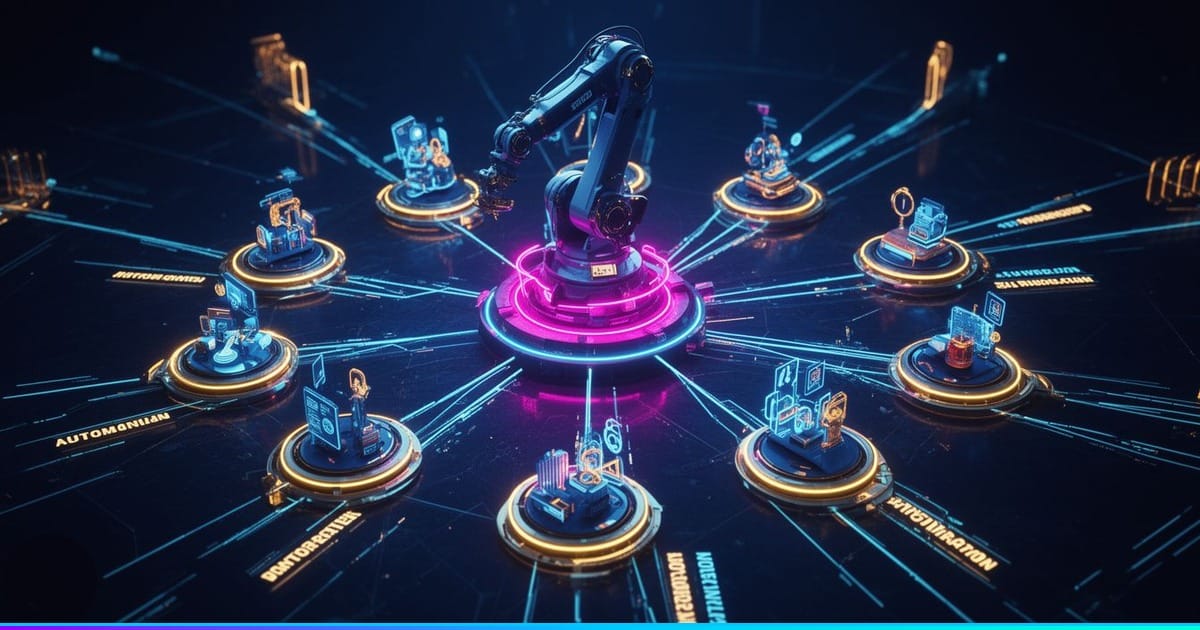
The way businesses automate routine tasks is undergoing a significant transformation, moving beyond simple, rigid systems. For years, Robotic Process Automation (RPA) has been the go-to tool for handling predictable, repetitive jobs. However, the rise of Artificial Intelligence (AI), particularly advanced tools like Large Language Models (LLMs), is ushering in a new era, making automation more adaptable and intelligent. This shift is crucial as businesses increasingly rely on digital processes to stay competitive.
From Fixed Rules to Flexible Understanding
RPA excels at following predefined steps, much like a digital assistant executing a checklist. This makes it ideal for structured information and straightforward processes. Yet, its limitations become apparent when faced with the messy, varied world of unstructured data – think emails, documents, or customer feedback. This is where AI shines, bringing the ability to understand context, interpret nuances, and adjust actions dynamically.
Tools like LLMs can now process and make sense of vast amounts of text, enabling them to summarize complex documents, pull out specific details, or even answer questions, all without needing explicit programming for every possible scenario. This adaptability means AI-powered automation can handle variations in input gracefully, something traditional RPA struggles with unless explicitly reconfigured.
The Era of “Intelligent Automation”
While RPA’s ability to automate structured tasks remains valuable, the future clearly lies in combining its strengths with AI’s interpretive power. Many companies are already adopting this hybrid approach, using AI to decode complex information and RPA to execute the subsequent steps efficiently. This blend creates what’s being called “intelligent automation,” a more sophisticated and capable form of digital assistance.
However, the integration isn’t as seamless as a simple upgrade. The article implies a smooth evolution, but true AI integration often demands careful data preparation and model training. Furthermore, while AI offers flexibility, its outputs can sometimes be unpredictable or inconsistent, posing challenges that need careful management. The focus on enhancing existing RPA rather than exploring AI’s potential to fundamentally rethink business processes suggests a cautious, evolutionary path.
🔍 Context
Robotic Process Automation (RPA) emerged to mimic human actions on digital systems, automating rule-based tasks. Artificial Intelligence (AI) encompasses systems that can perform tasks typically requiring human intelligence, like learning and problem-solving. Large Language Models (LLMs) are a type of AI adept at understanding and generating human language. The trend towards “Intelligent Automation” signifies the convergence of these technologies.
💡 AIUniverse Analysis
The narrative of AI enhancing RPA, leading to “intelligent automation,” is a pragmatic one, but it downplays the revolutionary potential of AI. While acknowledging AI’s ability to handle unstructured data, the article cautiously points out its limitations, such as inconsistent outputs. This suggests a focus on incremental improvements rather than a complete paradigm shift in how businesses operate.
The emphasis on combining RPA and AI, while sensible for many current use cases, might overlook opportunities for AI to enable entirely new business models and process designs. The challenges of data quality, ethical AI deployment, and the significant re-skilling required for a truly AI-driven workforce are also understated in this evolutionary view.
🎯 What This Means For You
Founders & Startups: Founders can leverage AI to build more adaptive and context-aware automation solutions that address unstructured data challenges.
Developers: Developers will need to integrate LLMs and machine learning models with existing RPA platforms to create intelligent automation workflows.
Enterprise & Mid-Market: Enterprises can achieve greater automation flexibility and efficiency by combining rule-based RPA with AI’s interpretive capabilities.
General Users: End-users may experience more intelligent and context-aware automated responses and streamlined interactions with business processes.
⚡ TL;DR
- What happened: Automation is evolving from rigid RPA to smarter, AI-enhanced systems.
- Why it matters: This makes businesses more flexible, efficient, and capable of handling complex data.
- What to do: Businesses should explore combining AI with their existing automation to unlock new capabilities.
📖 Key Terms
- Robotic Process Automation (RPA)
- Software robots that automate repetitive digital tasks by mimicking human actions.
- Artificial Intelligence (AI)
- Computer systems capable of performing tasks that typically require human intelligence, such as learning and problem-solving.
- Large Language Models (LLMs)
- A type of AI trained to understand, generate, and process human language.
- Intelligent Automation
- The integration of AI capabilities with automation technologies like RPA to create more sophisticated and adaptive processes.
Analysis based on reporting by AI Universe Source. Original article here.
Tools We Use for Working with AI: