

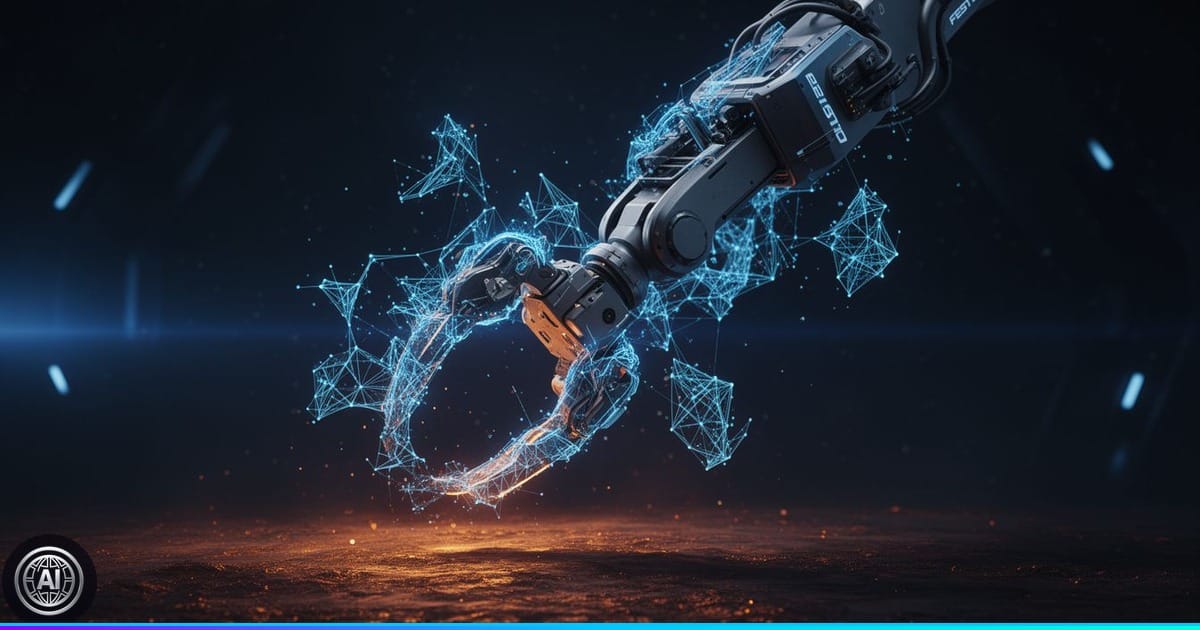
Festo’s AI-Powered Gripper Adapts to Unseen Objects Without Programming
Robotic automation is becoming more accessible as intelligent software begins to handle complex manipulation tasks previously requiring specialized programming. Festo’s new GripperAI software exemplifies this shift, enabling robots to grip objects they have never encountered before, even when those items are chaotically positioned. This advancement moves sophisticated object handling away from intricate coding and towards intuitive, AI-driven solutions.
Intelligent Gripping Demystifies Object Handling
Festo has introduced the HPPH two-finger pneumatic parallel gripper, a device designed for streamlined integration. This gripper consolidates the pneumatic control valve, position sensors, and electrical interface directly into its body. Weighing 1.5 lb (0.68 kg), the HPPH offers a maximum gripping force of 40.5 lbf (180 newtons) and can open up to 0.63 inches (16 mm), suitable for objects up to 2.2 lb (1 kg).
The true innovation lies in Festo’s GripperAI software, which allows robots to manage unfamiliar objects in disordered environments without any need for programming or teach-in training. This system is flexible, functioning with cobots, classic robots, and Cartesian handling systems, regardless of their manufacturer. By employing edge computing, GripperAI can operate efficiently using a low-cost 3D RGB-D camera and a basic CPU.
Bridging the Gap Between Hardware and Intelligent Software
The integration of the HPPH gripper with GripperAI was put to the test by the Würth Group in their logistics operations. There, the system was used to successfully empty crates containing mixed items. Jan Seyler, head of advanced development analytics and control at Festo, noted, “We built a copy of Würth’s sorter conveyors in our laboratory,” underscoring the practical development undertaken to validate the technology.
However, this integrated approach comes with trade-offs. The HPPH gripper is not intended for machining or environments exposed to aggressive media, grinding dust, or welding splatter. This limitation contrasts with more rugged industrial grippers that can endure harsher conditions but often involve greater weight and complexity, indicating a balance struck between collaborative robot compatibility and environmental resilience.
📊 Key Numbers
- HPPH Gripper Weight: 1.5 lb (0.68 kg)
- HPPH Maximum Gripping Force: 40.5 lbf (180 newtons)
- HPPH Maximum Gripper Opening: 0.63 in (16 mm)
- HPPH Suitable Object Weight: Up to 2.2 lb (1 kg)
- GripperAI Compatibility: Robot-agnostic (cobots, classic robots, Cartesian handling systems)
- GripperAI Computing: Operates with edge computing, 3D RGB-D camera, and basic CPU
🔍 Context
The Würth Group’s logistics operations provided a real-world testbed for Festo’s GripperAI, demonstrating its capability to handle mixed items without prior programming. This announcement addresses a persistent gap in robotic automation: the difficulty and expense of reconfiguring robots for new or unpredictable tasks. It aligns with a broader industry trend towards more adaptable and accessible automation solutions, moving away from highly specialized, labor-intensive setup.
While GripperAI offers an AI-driven approach to object recognition and manipulation, it is important to note its limitations. The HPPH hardware is not suited for environments with aggressive media or debris, distinguishing it from heavier-duty industrial grippers. This suggests a design choice prioritizing ease of integration and collaborative robot use over extreme environmental robustness.
💡 AIUniverse Analysis
Festo’s GripperAI represents a significant step in democratizing advanced robotic manipulation. By removing the need for programming or teach-in, the software allows for rapid deployment and adaptation in dynamic environments, fundamentally changing how companies can approach picking and sorting tasks. The combination of intelligent software with integrated hardware lowers the barrier to entry for sophisticated automation.
The key limitation lies in the hardware’s environmental constraints. While GripperAI’s intelligence is a breakthrough, the HPPH gripper’s unsuitability for harsh conditions means this solution is primarily targeted at less demanding environments like logistics or assembly, rather than heavy manufacturing. This creates a clear segmentation, with specialized, more robust grippers still essential for those challenging industrial settings.
For this technology to truly transform automation, Festo must demonstrate its efficacy across a wider range of object types and environmental conditions, while also ensuring the longevity and robustness of the GripperAI software’s learning capabilities over time.
⚖️ AIUniverse Verdict
✅ Promising. The ability of GripperAI to handle unseen objects without programming addresses a significant challenge in robotic automation, though its utility is currently constrained by the environmental limitations of the accompanying HPPH gripper.
🎯 What This Means For You
Founders & Startups: Founders can leverage Festo’s integrated solutions to rapidly prototype and deploy robotic applications that previously required extensive custom engineering.
Developers: Developers can significantly reduce integration time and complexity by utilizing pre-certified safety functions and embedded controls within the HPPH gripper.
Enterprise & Mid-Market: Enterprises can achieve faster deployment and greater flexibility in material handling tasks by adopting GripperAI’s programming-free object recognition and handling capabilities.
General Users: End-users in manufacturing and logistics may see increased automation efficiency and adaptability in handling diverse or unpredictable item arrangements.
⚡ TL;DR
- What happened: Festo launched the HPPH gripper with GripperAI software, allowing robots to pick up unknown items without programming.
- Why it matters: This makes advanced robotic manipulation more accessible, reducing setup time and complexity for automation.
- What to do: Consider GripperAI for logistics and assembly tasks where object variability is high but environmental conditions are mild.
📖 Key Terms
- pneumatic gripper
- A robotic end-effector that uses compressed air to actuate its gripping jaws.
- cobots
- Collaborative robots designed to work alongside humans in shared workspaces.
- IO-link
- A standardized industrial communication protocol for connecting sensors and actuators to automation systems.
- GripperAI
- Festo’s software that enables robots to identify and grip unknown objects without prior programming.
- edge computing
- Processing data closer to its source, rather than sending it to a centralized cloud server, for faster response times.
Analysis based on reporting by The Robot Report. Original article here.