

Kimi’s Agent Swarm Puts 100 AI Workers on Your Task — and Finishes 4.5x Faster Than Doing It One Step at a Time
The question of how AI gets complex work done just shifted — from making a single agent smarter to deploying an entire workforce of them simultaneously. Moonshot AI’s Kimi has released Agent Swarm, a system that dispatches up to 100 sub-agents working in parallel, completing long-horizon tasks — those requiring many sequential steps and decisions over time — 4.5 times faster than running the same work end-to-end through a single agent. That number, drawn directly from Kimi’s release documentation, is not a marginal improvement; it reflects a structural change in how AI systems are being designed to tackle complexity.
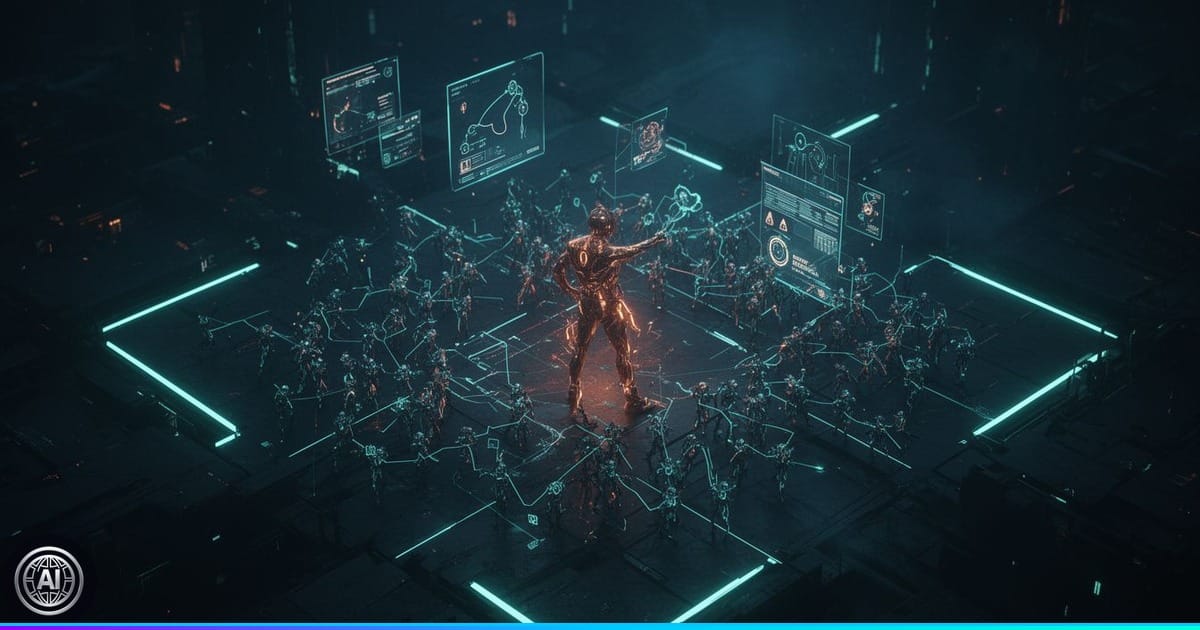
Agent Swarm does not simply split a task into pieces. According to Kimi’s own product release notes, the system self-directs 100 sub-agents based on a single user prompt, organizing them into a hierarchy that mirrors a corporate structure — with coordinating agents acting as managers, specialized agents functioning as individual contributors, and distinct divisions handling separate workstreams. The system can execute over 1,500 tool calls within a single session, a figure that underscores the operational scale involved. This is not a chatbot with extra steps. It is a self-assembling organization that exists for the duration of your query.
Access to Agent Swarm is currently limited to Top Tier Subscribers on the Kimi platform, signaling that Moonshot AI is treating this as a premium capability — one that carries real computational weight and, presumably, real cost. The constraint matters: it tells us something about who this is actually built for, and what the trade-offs look like at scale.
From Single Agent to Self-Organizing System: What Agent Swarm Actually Does
The architectural leap in Agent Swarm is not raw speed — it is the shift from human-directed task decomposition to machine-directed organizational design. When a user submits a prompt, Kimi’s system determines how to structure the workforce itself: which sub-agents to “hire,” what roles they play, and how their outputs get reconciled. This self-designing quality is what Kimi’s release documentation describes as the reconstruction of the entire workshop — captured in the system’s own framing: “It is not a better hammer. It is a reconstruction of the entire workshop.”
The use cases Kimi highlights in its product documentation are deliberately varied to demonstrate range. One involves identifying the top three creators across 100 niche YouTube domains — a task requiring simultaneous research across hundreds of data points that would be prohibitively slow in sequence. Another involves generating a 100-page literature review synthesized from forty social psychology PDFs, a task that demands both breadth and structured argumentation. A third deploys multiple expert personas to review a complex product launch from different professional angles simultaneously. And in a more creative register, Agent Swarm can be directed to have multiple writers produce alternative endings for Liu Cixin’s novel “The Three-Body Problem” — each writer-agent working independently before outputs are compared. The diversity of these examples is intentional: Kimi is positioning Agent Swarm as domain-agnostic.
One of the more technically consequential design choices, noted in Kimi’s release documentation, is the system’s explicit mechanism for avoiding groupthink — the tendency of collaborative systems to converge prematurely on a single answer. Agent Swarm forces reconciliation of differing agent conclusions rather than allowing majority consensus to override minority findings. In practice, this means the system is designed to surface disagreement, not suppress it. For analytical tasks where the wrong answer is worse than no answer, that design choice carries real weight.
The Organizational Metaphor Has a Shadow: Oversight, Cost, and Control
The organizational metaphor Kimi uses — bosses, employees, divisions of labor — is clarifying, but it also surfaces the system’s most significant unresolved tensions. Real organizations are hard to audit. When 100 sub-agents are executing over 1,500 tool calls in parallel, the question of which agent made which decision, and why, becomes genuinely difficult to answer. Kimi’s release notes do not describe a debugging interface or a transparency layer that would allow a user — or an enterprise compliance team — to trace a specific output back to a specific sub-agent’s reasoning chain. For critical applications, that gap is not cosmetic.
The cost dimension is equally underexamined in Kimi’s public framing. Running 100 parallel sub-agents through 1,500 tool calls is computationally expensive by definition. The 4.5x speed advantage is real, but speed and cost are not the same variable. A task completed 4.5 times faster may still cost significantly more in aggregate compute than a well-designed single-agent workflow — particularly if the task does not actually require that level of parallelism. The current restriction to Top Tier Subscribers is likely a reflection of this reality, not just a monetization strategy.
Kimi’s roadmap, as described in its release documentation, includes two forthcoming capabilities: direct sub-agent communication — meaning agents will be able to coordinate laterally, not just report upward — and dynamic control of parallel width, allowing the system to adjust how many agents are deployed mid-task. Both features expand the system’s flexibility, but direct inter-agent communication introduces new vectors for cascading errors and, potentially, security considerations that have not yet been publicly addressed. A cautious enterprise architect would want to see those communication channels audited before deploying Agent Swarm on sensitive internal data.
📊 Key Numbers
- Parallel sub-agents deployed: Up to 100 sub-agents dispatched simultaneously from a single user prompt
- Tool calls per session: Over 1,500 tool calls executable within a single Agent Swarm session
- Speed advantage over sequential execution: 4.5x faster than running equivalent tasks end-to-end through a single agent
- Literature review scale: 100-page output synthesized from forty source PDFs in a single session
- Domain breadth benchmark: Simultaneous research across 100 niche YouTube domains to surface top-3 creators per domain
- Availability tier: Currently restricted to Top Tier Subscribers on the Kimi platform
- Direct sub-agent communication: Future iterations will allow for direct communication between sub-agents
- Dynamic parallel width control: Future updates will include dynamic adjustment of parallel execution width
🔍 Context
The specific gap Agent Swarm addresses is the ceiling that single-agent architectures hit on tasks requiring simultaneous, heterogeneous reasoning — research synthesis, multi-perspective analysis, and large-scale data aggregation that cannot be meaningfully parallelized by a single model running sequentially. Prior to systems like Agent Swarm, the standard approach was either human-directed multi-agent orchestration — where a developer manually defines agent roles and handoffs — or sequential single-agent chaining, both of which impose hard limits on throughput and task complexity. Agent Swarm’s self-designing organizational layer removes the human from the orchestration step entirely, which is the architectural novelty here. This fits within a broader industry trajectory away from test-time scaling — the practice of giving a single model more compute at inference time to improve output quality — and toward what might be called organizational scaling: distributing reasoning across many specialized agents rather than deepening it within one. Rather than competing with a named commercial rival, Agent Swarm’s most direct architectural contrast is with bespoke multi-agent pipelines built by hand, where developers write explicit coordination logic — a process that is slower to build and harder to generalize across task types. The timing of this release aligns with Kimi’s own product maturation: the release documentation positions Agent Swarm as the next layer above Kimi’s existing long-context and single-agent capabilities, suggesting the infrastructure to support 100-agent parallelism was a prerequisite that has only recently been met.
💡 AIUniverse Analysis
Our reading: The genuine advance in Agent Swarm is not the parallelism itself — running multiple processes simultaneously is not new — but the self-directed organizational design. The fact that a user submits one prompt and the system determines its own workforce structure, role assignments, and reconciliation logic removes a layer of engineering overhead that has historically made multi-agent systems expensive to build and brittle to maintain. The anti-groupthink mechanism, which forces reconciliation of conflicting agent conclusions rather than defaulting to consensus, is a specific and defensible design choice that distinguishes Agent Swarm from simpler ensemble approaches. That is a real architectural contribution.
The shadow is the opacity problem, and it is not small. When 100 agents execute over 1,500 tool calls and the system self-designs its own hierarchy, the resulting output is the product of a process that no human directly supervised. Kimi’s documentation does not describe how a user would identify which sub-agent introduced an error, which tool call returned a bad result, or how the reconciliation logic resolved a conflict between two agents with opposing conclusions. For creative tasks like writing alternative endings to “The Three-Body Problem,” that opacity is acceptable. For enterprise use cases involving legal research, financial analysis, or medical literature synthesis, it is a structural liability. The 4.5x speed figure also deserves scrutiny: Kimi’s release notes do not specify the baseline conditions under which that measurement was taken, which makes it difficult to evaluate whether it holds across task types or represents a best-case scenario.
For Agent Swarm to matter in twelve months, Moonshot AI will need to ship the transparency and debugging infrastructure that enterprise buyers require — specifically, a way to audit individual sub-agent decisions and trace outputs back through the organizational hierarchy it creates. Without that, the system’s ceiling is power users and research workflows, not the enterprise deployments that would validate the organizational-AI thesis at scale.
⚖️ AIUniverse Verdict
👀 Watch this space. The self-organizing 100-agent architecture and the 4.5x speed gain over sequential execution are credible and specific, but the absence of any described audit trail or debugging layer means enterprise adoption depends on infrastructure Kimi has not yet shipped.
🎯 What This Means For You
Founders & Startups: Agent Swarm’s ability to synthesize 40 PDFs into a 100-page literature review or map 100 niche domains simultaneously makes it a practical tool for rapid competitive research and market analysis — tasks that previously required either significant human hours or expensive custom pipelines.
Developers: The shift to self-directed agent orchestration means the design challenge moves upstream: instead of writing coordination logic, developers will need to learn how to write prompts that reliably produce the organizational structures Agent Swarm needs to perform well — a new skill set with limited documentation so far.
Enterprise & Mid-Market: Before deploying Agent Swarm on sensitive internal data, enterprise teams should treat the current version as a research and prototyping tool only — the lack of a described audit trail for 1,500+ tool calls across 100 sub-agents is a compliance gap that needs resolution before production use.
General Users: Top Tier Subscribers can experiment now with the creative and research use cases Kimi has documented — multi-perspective product reviews, large-scale content synthesis, and creative writing tasks — but should validate outputs carefully, since the system’s self-designed structure makes it harder to spot where errors entered the process.
⚡ TL;DR
- What happened: Moonshot AI’s Kimi released Agent Swarm, a system that deploys up to 100 parallel sub-agents from a single prompt, executing over 1,500 tool calls at 4.5x the speed of sequential AI execution.
- Why it matters: The system self-designs its own organizational hierarchy — removing the human from the orchestration step — which is a structural shift in how multi-agent AI systems are built and deployed.
- What to do: Top Tier Subscribers should test Agent Swarm on bounded research tasks now, while watching for Kimi’s promised updates on direct sub-agent communication and dynamic parallel width control — those features will determine whether the system is viable for high-stakes applications.
📖 Key Terms
- Agent Swarm
- Kimi’s multi-agent system that deploys up to 100 specialized sub-agents in parallel from a single user prompt, self-organizing them into a hierarchical workforce to complete complex tasks faster than any sequential approach could.
- Sub-agents
- Individual AI workers within Agent Swarm, each assigned a specific role or task by the system’s coordinating layer — analogous to employees in a temporary organization assembled for a single project.
- Sequential execution
- The conventional approach where an AI model completes one step before starting the next; Agent Swarm’s 4.5x speed advantage is measured against this baseline.
- Long-horizon tasks
- Tasks that require many dependent steps, decisions, or information-gathering actions over time — the category of work Agent Swarm is specifically designed to accelerate by running those steps in parallel rather than in order.
- Test-time scaling
- A technique that gives a single AI model more computational resources at the moment it generates a response to improve output quality; Agent Swarm represents an alternative strategy that distributes reasoning across many agents instead of deepening it within one.
Analysis based on reporting by Kimi / Moonshot AI. Original article here.